


Developers and consumers of AI glasses envision a new future
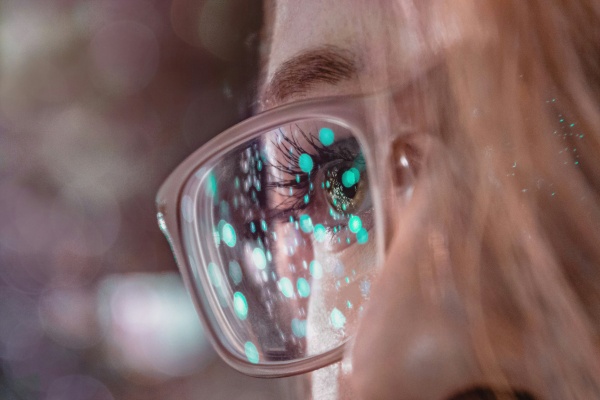
[Person wearing glasses that is reflected on screen, credit to Unsplash]
Interviews with a developer and two consumers conducted in September 2026 revealed how AI glasses are beginning to change how people interact with the world.
AI glasses integrate microchips, batteries, and sensors that allow them to receive AI-powered assistance, and process information from their surroundings.
According to a product planner for a global device manufacturer, AI glasses could become an “interface” through which people could naturally interact with AI.
They also mentioned that, unlike smartphones, AI glasses have the ability to gather information from the user’s perspective.
One consumer said that the process of pulling out a smartphone to search or type will disappear, shifting instead to a model where the situations people see and hear will serve as the inquiries of AI.
They believe that tasks such as navigation, translation, and memory assistance will provide people with opportunities to connect deeper with their surroundings.
These responses show that AI is moving from something people actively access to something that people embed in their surroundings.
Despite these possibilities, current AI glasses still face limitations that prevent them from completely replacing smartphones.
Consumer 2 mentioned that AI glasses are simply enjoyable and provide convenience.
However, they mentioned that they still rely heavily on their main device due to its limitations.
They mentioned that AI glasses have their limitations, and that continuous advancements and updates must be made in order for the technology to seamlessly blend in with an individual’s daily life.
According to the developer, the current limitations AI glasses include cultural context, audio/visual information, and interpersonal relationships.
However, the technology is expected to become much more capable.
AI will improve its ability to interpret that information in context and determine when/how to use it.
The biggest probability of AI glasses is that they will become capable enough to constantly understand the user's environment.
However, consumers are concerned about whether the product will eventually be naturally accepted by the public.
One consumer mentioned that they find themselves “quite conscious of whether those around me might feel uncomfortable whenever I wear the device.”
They emphasized that AI glasses must develop factors that foster trust in order for it to be accepted like smartphones and cameras.
They emphasized that features such as recording indicators and transparency regarding data will be crucial in order to develop fidelity.
If these issues are addressed, AI glasses could gain greater public acceptance.
Unlike a phone, AI wouldn't require the user to consciously take out a device.
AI could be available whenever the user needs it.
By equipping AI glasses, users can provide AI access to information on their perspective without actively interacting with a screen, providing a new level of convenience.
This shift is constantly attracting consumers who already recognize AI as more than a wearable device.
Despite these advancements, current AI glasses still face limitations that prevent them from fully replacing smartphones.
The developer pointed out that this might enable AI to take care of routine tasks, freeing people to concentrate more completely on the individuals and circumstances around them.
Yet, having AI always within reach could likewise cause people to engage more with their AI than with those around them.
Consumer 1 stressed that AI should broaden the options available to people while still leaving the ultimate choices in human hands.
As AI glasses keep evolving, their effects may extend past the technology itself and into how people experience and engage with the world.
Ultimately, the future of AI glasses may hinge not just on how much AI is able to comprehend, but on how people decide to weave it into their daily lives.

- Jungyeon Yim / Grade 10
- Saint Paul Preparatory Seoul