
![THE HERALD STUDENT REPORTERS [US]](/assets/images/logo_student_us.png)
![THE HERALD STUDENT REPORTERS [Canada]](/assets/images/logo_student_ca.png)

Death toll from Nepal-Tibet flash flood surpasses 900 as more than 4,000 remain missing and barrier lake threatens second surge
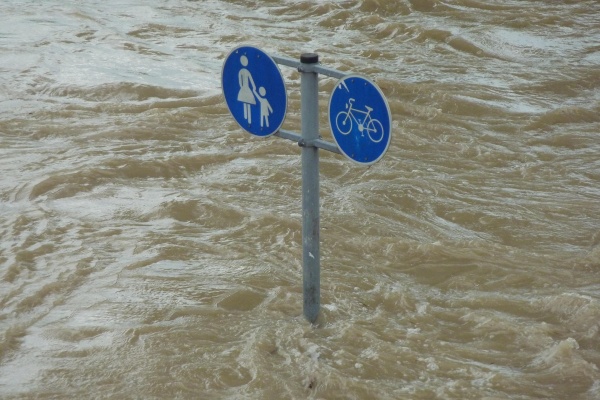
[Image of a flood sign, Credit to Pixabay]
The death toll from the flash flood that struck the Nepal-Tibet border region last week has climbed to at least 903 in Nepal alone, with another 4,247 people reported missing and 1,473 injured, according to figures released on August 31 by Nepal’s National Disaster Risk Reduction and Management Authority.
The disaster began at approximately 8:40 a.m. local time on August 26, when a large section of glacier near the Langatang Lirung peak in the Himalayas broke away at an elevation of about 5,200 meters and plunged roughly 1,200 meters into the valley below, triggering a cascading ice-and-rock avalanche.
The avalanche struck the Lhende River in Tibet, about 20 kilometers northeast of the Nepal-China border crossing, briefly damming the waterway before the natural barrier collapsed and unleashed a surge of water, mud, ice, and rock that reached the Gyirong border checkpoint within six to seven minutes.
Initial reports suggested that a magnitude 4.4 earthquake had caused the collapse, but the United States Geological Survey later clarified that the seismic signal originated from the landslide itself, which registered as a magnitude 5.2 event.
Waves reported to be nearly 30 feet high surged downstream through mountainous river valleys, obliterating communities for miles, with the worst damage in Nepal concentrated in the Rasuwa district immediately south of the Chinese border.
In Tibet’s Gyirong County, Chinese officials confirmed 16 deaths and at least 546 people missing as of August 29, with rescue teams reporting that most structures within the mudslide’s impact zone had been leveled and that no signs of survivors had been found at the border checkpoint.
Foreign nationals account for approximately 592 of the missing in Nepal, including 288 Indian nationals, 90 Americans, 53 Ukrainians, 51 Malaysians, 35 Australians, and 33 United Kingdom nationals, while the Chinese Ministry of Foreign Affairs has reported that nearly 100 Chinese citizens in Nepal are also unaccounted for.
Many of the missing were Hindu pilgrims en route to Mount Kailash and Lake Mansarovar in Tibet, including a group of 77 members of India’s Isha Foundation from 19 different nationalities who were at Gyirong Port when the flood struck.
Nepal has deployed roughly 30,000 security personnel to search remote valleys, and disaster authorities reported that 7,514 people had been rescued by August 29, including 227 foreign nationals, with helicopters providing the only viable route into many affected areas.
Bishal Nath Upreti, president of the Nepal Centre for Disaster Management, told Al Jazeera that approximately 42 kilometers of road had been completely destroyed, forcing rescuers to rely almost entirely on helicopters to reach survivors.
“They are very desperate now,” Upreti added, noting that stranded residents had been without shelter or food for more than 72 hours.
Authorities are now monitoring a secondary threat after a new lake formed at the site of the original collapse and began overflowing on August 30, prompting Chinese authorities to issue flood warnings for downstream areas along the Trishuli and Gandak river systems, including regions across the border in India.
At a regional government press conference in Tibet,Chinese officials said the barrier lake had begun to discharge water but described the overall situation as stable, adding that the possibility of a complete breach was assessed as relatively low.
The United States State Department announced on August 30 that it would provide more than $3.6 million in humanitarian assistance to Nepal, an increase from an initial pledge of $500,000, including up to three months of emergency flood aid for as many as 10,000 flood survivors.
Scientists have suggested that climate change likely contributed to the conditions that led to the glacier collapse, though researchers investigating the event have cautioned that a direct causal link between global warming and this specific disaster has not yet been established.
The Intergovernmental Panel on Climate Change has previously reported with high confidence that glacier retreat and permafrost thaw have decreased mountain slope stability across high-altitude regions, and researchers warn that similar catastrophic events in the Himalayas are likely to increase in frequency as global warming persists.
Nepal’s Office of the Prime Minister has extended condolences to bereaved families and established an emergency control room to coordinate the search for foreign nationals and manage consular assistance for affected countries.

- Alice Hong / Grade 11
- The Madeira School