
![THE HERALD STUDENT REPORTERS [US]](/assets/images/logo_student_us.png)
![THE HERALD STUDENT REPORTERS [Canada]](/assets/images/logo_student_ca.png)

Artemis II finalizes its launch on April 10, 2026 on the coast on San Diego
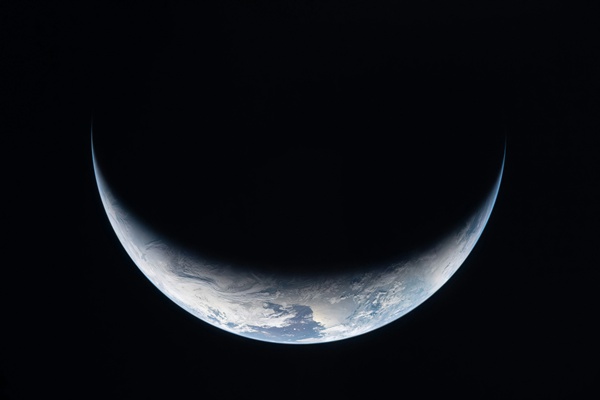
[Distant Earth from moon. Photo credits to Unsplash]
The world held its breath on the evening of April 10, 2026, as the massive, heroic capsule descended under three massive orange and white parachutes off the coast of San Diego.
At 8:07 p.m. EDT, NASA’s Orion spacecraft officially splashed down in the Pacific Ocean, successfully concluding the Artemis II mission.
This moment marked the first time in over 50 years - since the final Apollo mission in 1972 - that human beings have ventured across the mysterious lunar space.
The fascinating journey began on April 1, 2026.
According to the Canadian Space Agency, at 6:35 p.m EDT, the Space Launch System(SLS) set the Florida afternoon sky ablaze, as the majestic spaceship lifted off from the Kennedy Space Center.
Onboard were four pioneers: Commander Reid Wiseman, Pilot Victor Glover, and mission specialist Christina Koch and Jeremy Hansen.
This diverse team of astronauts were more than just a flight crew.
They were the faces of the new era, the ones that would open and lead the way into the unknown atmosphere.
Over the course of 9 days, 1 hour, and 32 minutes, the Orion spacecraft pushed further into the cosmos than any human vehicle had ever done before.
This mission was a lunar flyby mission - where the spacecraft rotates around the moon and does not land on the lunar surface - instead of a landing mission.
The crew reached a maximum distance of 252,760 miles from Earth.
This feat shattered the previous distance record held by the legendary Apollo 13 mission by exactly 4,105 miles, making these four individuals the furthest traveling humans from our Earth.
As the crew swung around the lunar far side, the astronauts passed within a mere 4,070 miles of a moon crater.
Throughout this adventure, the four were required to perform mission-critical activities.
They conducted manual spacecraft operations to ensure that humans knew how to plan and act if automated systems ever failed during future landings.
Moreover, NASA reports that the astronauts also monitored Orion’s navigation system and propulsion, proving that the spaceship could protect its inhabitants against the freezing temperatures and radiation vacuum.
But the question remains, why send people to space when we have advanced robotics?
NASA scientists emphasize that the elements that humans gain when born are incomparable to metal machines.
They note that “human eyes are especially sensitive to light, texture, and other surface characteristics.”
While a robot can capture high-resolution photos, an astronaut can spot subtle geological features in real-time.
Moreover, the crews participated in human health studies to see how the body reacts to deep space, providing essential data that will be crucial for the next centuries that connect to planets during the flight.
As the sun sets over the Pacific and the crew begins their journey from San Diego, the distance the team traveled tells a story of triumph.
Now the world eagerly anticipates Artemis III.
For countless people, this mission transcended being just a technical flight.
As the Orion recovered from the waves of the American coast., the distant moon waits to welcome humanity back home.

- Seungyeon Shin / Grade 7
- International School Manila