
![THE HERALD STUDENT REPORTERS [US]](/assets/images/logo_student_us.png)
![THE HERALD STUDENT REPORTERS [Canada]](/assets/images/logo_student_ca.png)

Streamers scale back film spending as box office rebounds in early 2026 By Dongmin Lee
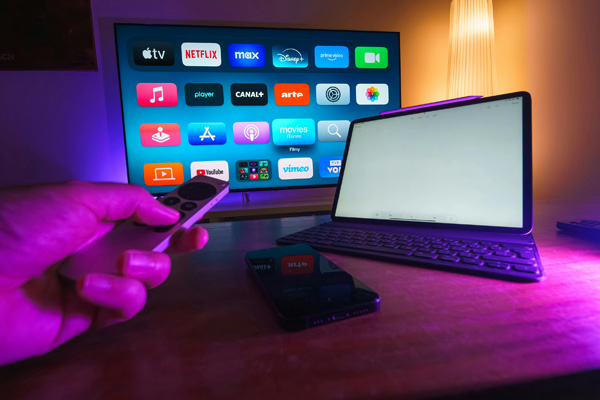
[A group of streaming platforms displayed on Apple TV. Photo Credit to Pexels]
U.S. domestic box office revenue ran 23% above last year's pace through mid-April 2026, with ticket sales up 16%, even as major streamers trimmed their film production budgets.
Universal's "The Super Mario Galaxy Movie" leads the year at $363.7 million domestically, followed by Amazon MGM's "Project Hail Mary" at $290.9 million and Disney's "Hoppers" third at $162.1 million.
The first three months of 2026 yielded $1.77 billion domestically, the strongest opening quarter since the pandemic disrupted cinema operations.
Year-to-date box office revenue climbed 23% above the same period of 2025, and ticket sales rose 16% over the same comparison.
Exhibitor confidence was evident at CinemaCon, where attendance rose five percent year over year and analysts at MoffettNathanson declared that the long-awaited box office rebound finally arrived.
AMC chief executive Adam Aron called the 2026 slate the strongest since 2019, while MoffettNathanson cautioned that full cash-flow recovery may require another strong year in 2027.
Theater operators are optimistic, pointing to a crowded 2026 lineup that includes "Avengers: Doomsday," Christopher Nolan's "The Odyssey," "Toy Story 5," "Spider-Man: Brand New Day," and a new "Star Wars" release.
However, significant theatrical headwinds persist, as Look Dine-In and iPic filed for bankruptcy, AMC announced plans to close underperforming locations, and annual ticket sales remain roughly 20% below pre-pandemic levels.
Studio retrenchment accompanied the exhibitor recovery as Disney eliminated up to 1,000 jobs, Sony announced layoffs, and Paramount Skydance committed to releasing 30 films per year after acquiring Warner Bros. Discovery assets.
On April 22, 2026, Netflix's board authorized a $25 billion share buyback, diverting funds toward shareholders rather than larger content commitments.
The authorization carried no expiration date and added to a December 2024 program that still held $6.8 billion unspent.
Netflix co-CEOs Ted Sarandos and Greg Peters continue leading the company after Chairman Reed Hastings announced plans to step away from the board after June 2026.
The company maintained its 2026 content budget at $20 billion for films and series, a reduction from earlier forecasts that had projected larger increases.
The buyback followed Netflix’s first-quarter earnings release, which included a $2.8 billion termination fee collected after the company withdrew from an $82 billion deal for Warner Bros. Discovery assets in late February 2026.
Excluding the termination fee, underlying quarterly earnings per share dropped to roughly $0.58 against the reported $1.23, and second-quarter revenue guidance of $12.574 billion landed slightly below analyst estimates.
The windfall boosted Netflix's 2026 free cash flow forecast to $12.5 billion, with cash reserves reaching $12.3 billion at the end of the first quarter.
Industry analysts at AlixPartners forecast the global subscription streaming market will exceed $165 billion in 2026 while subscriber growth slows to roughly five percent.
The same report forecasts annual growth falling under two percent by 2030, which will further push platforms toward hybrid advertising tiers, live sports rights, and cost-sharing partnerships with legacy broadcasters.
AlixPartners highlighted emerging alliances between streamers and broadcasters, cooperating on content, technology, and distribution to offset duplicate spending.
The firm also noted converging platforms, citing YouTube's push into Netflix-style premium subscriptions and Netflix's expansion into short-form mobile formats targeting advertisers.
Younger audiences played a pivotal role in the theatrical resurgence as Gen Z attended more films than any other demographic, according to Fandango's January 2026 moviegoing study of more than 5,000 respondents.
The survey found that 87% of Gen Z viewers caught at least one theatrical release in 2025 compared with 76% of all US adults, averaging 7.2 visits per year against the national average of 5.3.
Gen Z attendees also leaned digital and social, with 92% buying tickets online and a strong preference for pairing screenings with dining or drinking.

- Dongmin Lee / Grade 10
- Seoul Scholars International