
![THE HERALD STUDENT REPORTERS [US]](/assets/images/logo_student_us.png)
![THE HERALD STUDENT REPORTERS [Canada]](/assets/images/logo_student_ca.png)

The Asian Art Museum features Park Dae-sung’s reinterpretation of the Western landscape
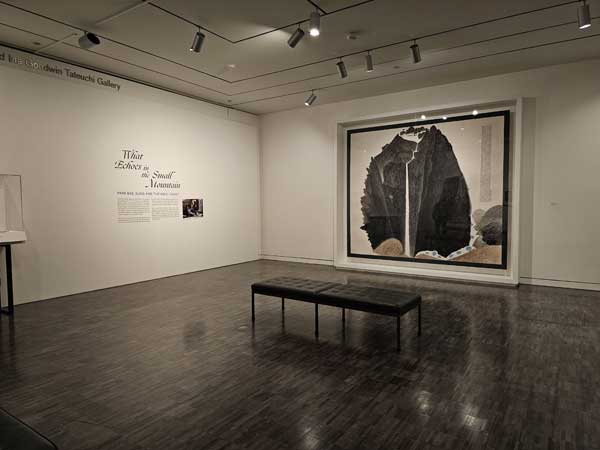
[The “Echoes in the Small Mountain” exhibition at the Asian Art Museum, Photo Credit: Yujun Lee]
The Asian Art Museum in San Francisco opened a special exhibit titled “Echoes in the Small Mountain: Park Dae-sung and the West Coast” on December 11, 2025.
Located at the Tateuchi Gallery on the second floor of the museum, this exhibition features paintings of the artist Park Dae-sung.
Park Dae-sung, who has a pen name “Sosan” meaning a small mountain, is a Korean contemporary artist known for his style based on Sumukhwa, Korean traditional ink wash painting, and his reinvention of the techniques in a modern way.
Born in 1945, Park Dae-sung lost both of his parents and his left arm during the Korean War.
His pen name ”Sosan” was given by his grandfather when he was 19.
Like the pen name that implies that regardless of the size, a mountain still is a mountain, Park Dae-sung overcame his absence of a limb and became a successful artist.
He did not attend a school after graduating from a middle school, and did not receive an education on art.
With countless practices, he was able to progress his skill, and only self-studying with no outside influence allowed him to develop his artistic style in a unique way, free from trends and existing styles.
By the 1970s, Park Dae-sung began to be recognized as a skilled Sumukhwa artist by many people, and has been continuing his artistic journey ever since.
His most celebrated artwork is the 1996 painting “Bulguk Seolgyeong,” or “Snow at Bulguk Temple.”
This masterpiece depicts a snowy landscape at the Bulguksa Temple in Gyeongju, where Park lived and focused on painting during the 1990s.
Though he is famous in Korea, his fame and reputation, however, reaches far beyond just Korea.
As a traditional Korean artist recognized by the Western world, he held several exhibitions outside of Korea, such as the Los Angeles County Museum of Art, Harvard University, and the Hood Museum of Art in Dartmouth University in 2022, and Charles B. Wang Center in Stony Brook University in New York in 2023.
This exhibition has a theme of Park Dae-sung’s depiction of the American West Coast using a traditional Korean technique.
Along with his 2025 painting “Yosemite,” it features three other paintings by Park Dae-sung, which were all donated to the museum 20 years ago, such as the painting “Nine Dragon Falls” that depicts the Guryong Waterfall in Korea.
Specifically, “Yosemite” is a meaningful painting of his, as it is his first landscape painting that depicts a place outside of Korea.
Prior to this painting, most of Park’s subjects were about the beautiful nature of Korea, especially of Gyeongju.
Through his painting that depicts the landscape of the Western world using Korean techniques, he reinterprets the Californian landscape and poses a new perspective on how people view the landscape.
The special exhibition will open for about seven months, until July 13, 2026.
The museum opens from Thursday to Monday, starting from 10 a.m. to 5 p.m., with general admission tickets priced $20 for adults and reduced fee for youth and seniors.
- Yujun Lee / Grade 12
- Homestead High School