
![THE HERALD STUDENT REPORTERS [US]](/assets/images/logo_student_us.png)
![THE HERALD STUDENT REPORTERS [Canada]](/assets/images/logo_student_ca.png)

World’s oldest rock found in the caves of Indonesia
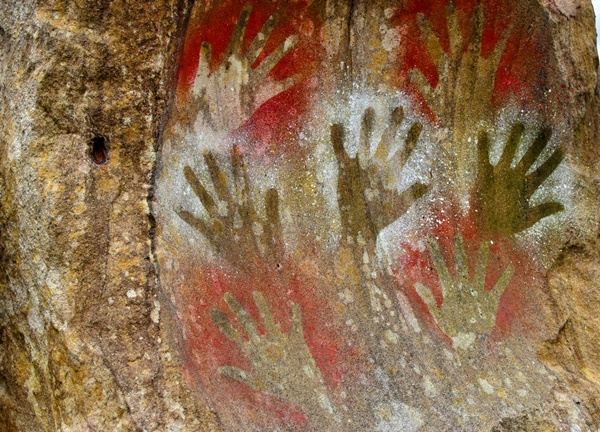
[A cave with human handprints/Photo Credit to Pexels]
On Muna Island in Indonesia, a human handprint was discovered deep inside a limestone cave; it may also be the oldest piece of rock art ever discovered.
Scientists estimate it is nearly 68,000 years old, which makes it very important for understanding early human history.
This ancient artwork helps people understand how early humans expressed themselves, and shows their creativity.
The hand prints were very simple yet a clever way to express art and their emotions.
A person would place their hand flat against the stone and blow a reddish-brown colored pigment around the hand.
So once the hand was removed, it would show a clear outline of a hand.
This method of art is called a hand stencil, and is known to be one the earliest known forms of art.
Even though the paintings look simple, they show that the early humans had ideas, and wanted to leave art for others to admire them.
To figure out how old the handprints really are, the Indonesian archaeologist named Adhi Agus Oktaviana and his team carefully studied the cave.
Not only did they analyze the paint, they also examined how many layers of minerals that formed on the artwork over time.
By studying these layers, scientists can more accurately determine when this artwork was created.
Their findings were published in the scientific journal called “Nature” in January 2026.
The findings were shocking. It showed that the oldest hand stencil was at least 67,800 years old.
This was a humongous discovery because it is about 30,000 years older than some of the other cave artwork previously found by other scientists.
This means that humans were creating art much earlier than what the scientists once had believed.
One interesting detail about the handprint is that the tip of one finger was modified to look sharp, like a claw.
This minor alteration tells the scientists that the person who drew this was not just copying what they saw, but using their imagination instead.
It shows people that early humans were capable of creative thinking and maybe even storytelling.
Dr Oktaviana stated that this proves that humans living during the Late Pleistocene period already possessed advanced skills.
The cave was not just used once, as scientists believe that people had returned to it over thousands of years.
Later, early humans added more drawings like pigs, boats, and human-like figures onto the rock.
This indicates that the cave might have been an important place for the early humans for generations.
This discovery also sheds light on how the early humans moved across the world.
Scientists believe that islands like Muna could have served as resting points during these long journeys, facilitating the spread of humans to new parts of the world.

- Carolynn Kim / Grade 7
- Apex Friendship Middle School