
![THE HERALD STUDENT REPORTERS [US]](/assets/images/logo_student_us.png)
![THE HERALD STUDENT REPORTERS [Canada]](/assets/images/logo_student_ca.png)

Development of cancer-fighting antibodies allows tumors growth to be slowed rapidly
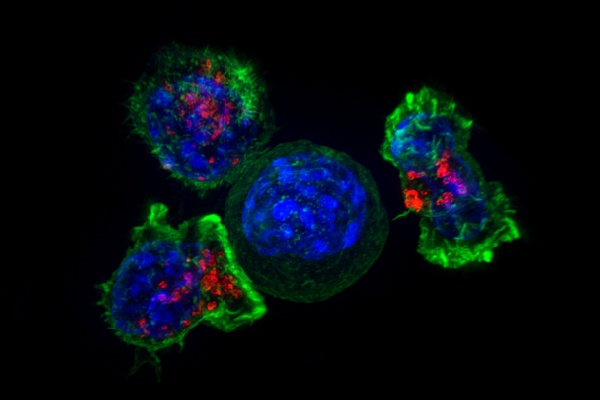
[A photo of a cancer cell being attacked. Photo Credit to Wikipedia Commons]
On June 17, 2026, a groundbreaking study was published in the journal Signal Transduction and Targeted Therapy that revealed the development of an antibody capable of slowing the growth of prostate cancer, one of the most prevalent cancers worldwide.
Researchers at Umeå University in Sweden developed a fully human monoclonal antibody designed to block a specific cancer-promoting process.
In pre-clinical trials, the drug considerably reduced tumor growth and prevented metastasis from occurring, a process in which cancer spreads to other body parts, a leading cause of death among prostate cancer patients.
Prostate cancer becomes most dangerous at the later stages, specifically when it develops into metastatic castration-resistant cancer, a stage where hormone treatments are no longer effective.
The new antibody treatment works by intercepting the transforming growth factor-beta pathway (TGF-β), which is crucial for the long-term survival of the tumor.
While this pathway can actually slow cancer growth initially, it accelerates tumor invasion and metastasis in the late stages, causing major harm to the diagnosed patient.
Thus, if pre-clinical trials are successful, the antibody will be administered into patients to block TGF-β from activating the processes necessary for the cancer to spread throughout the body, effectively halting it from further damaging them.
In lab and animal model studies, the antibody demonstrated various anti-cancer effects, with researchers observing slowed tumor growth, decreased cell invasion, and significantly suppressed metastasis.
In certain instances, its effectiveness was comparable to existing chemotherapy treatments, although more testing is required to approve the drug for widespread human use.
Maréne Landström, lead researcher of the study, comments that the treatment’s goal is stopping cancer at its most dangerous.
Landström states, “The new drug has been developed to prevent metastasis,” emphasizing that targeting the biomechanisms that actively spread cancer are the things that need to be addressed.
Despite promising early trial results, researchers still caution that the drug is at an experimental stage, with all the current findings being considered preclinical research, meaning human clinical trials have not been formally conducted.
Before the drug can be approved, it must undergo multiple rounds of human and animal testing to guarantee both its effectiveness and its safety.
This study reflects modern scientists’ inclination to research more targeted forms of cancer therapy, particularly those that use antibodies.
Unlike traditional treatments such as chemotherapy, which can harm healthy cells as well as cancer cells, these therapies are designed to target molecules that are only found within tumors, considerably reducing the risks and side effects of cancer treatment.
Looking ahead, researchers note that future work regarding the drug will be to test it in clinical trials and explore its effectiveness against other types of cancer.
If they are successful in their work, this advancement could mean a new age of tumor treatment, as more emphasis can be put on stopping the spread of deadly cancers rather than shrinking its size through therapies that have known side effects.

- Ian Kim / Grade 10 Session 7
- R.E. Mountain Secondary School