
![THE HERALD STUDENT REPORTERS [US]](/assets/images/logo_student_us.png)
![THE HERALD STUDENT REPORTERS [Canada]](/assets/images/logo_student_ca.png)

Microbes can be both a threat and a tool in space
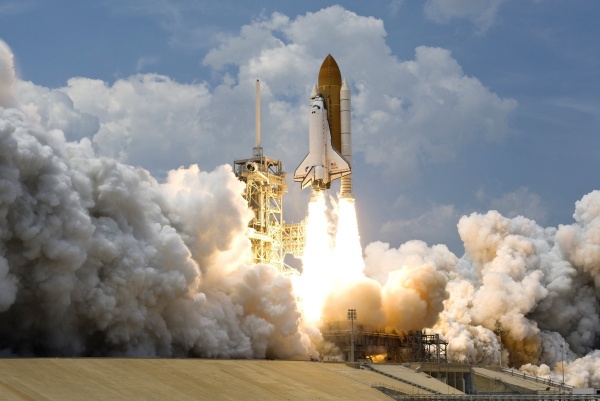
[Rocket Launch. Photo Credit to Pixabay]
In January 2026, a study in PLOS Biology found that microgravity can change how bacteria and bacteria-infecting viruses interact, raising new questions about how microbes may behave during long space missions.
Scientists examined the T7 bacteriophage, a virus that infects bacteria, and E. coli, a common type of bacteria used in labs.
The experiment was conducted on the International Space Station.
The study revealed that microgravity altered the virus-bacteria interaction.
At first, the virus infected the bacteria at a slower rate in space.
Over time, researchers identified new mutations in both the virus and the bacteria that may have improved their fitness in microgravity.
Some of the space-adapted viruses even became better at infecting certain antibiotic-resistant bacteria.
This may sound like a small science experiment, but it brings up a much bigger question: What happens to microbes when humans go to space?
Many people imagine spacecraft as perfectly clean and almost germ-free.
But this is not the case.
Astronauts carry microbes with them on their skin, inside their bodies, and through the air they breathe.
Bacteria, fungi, and viruses can thrive on walls, equipment, water systems, and other surfaces inside a spacecraft.
The International Space Station is not only a science lab.
It is also a small closed environment where humans and microbes coexist.
A 2025 study in Cell collected 803 samples from the U.S. section of the space station and created a microbial map.
The researchers found that different areas of the station were home to different types of microbes.
Places used for food, hygiene, work, and storage all had distinct microbial patterns.
This is important because space is very different from Earth.
In microgravity, liquids behave differently.
Bacteria may exhibit altered growth patterns, attach to surfaces more easily, or respond to stress in new ways.
One major concern is biofilm formation.
A biofilm is a sticky layer of microbes that can form on a surface.
On Earth, biofilms can form on teeth, pipes, and medical equipment.
In space, biofilms could pose a challenge if they grow inside water systems or on spacecraft equipment.
They are hard to remove and may protect bacteria from cleaning methods or antibiotics.
NASA is also studying how microbes adapt to microgravity, including how some bacteria may respond to antibiotics in space.
In 2026, NASA described an experiment on the space station in which astronauts processed microbial samples related to antibiotic-resistant organisms and prepared them for DNA extraction and analysis.
Scientists plan to use the data to better understand how bacteria change in microgravity. One group of bacteria was treated with an antibiotic, while another group was not.
Scientists planned to analyze the DNA of the bacteria to understand how they changed in space.
This kind of research matters because astronauts may spend months traveling to Mars in a closed spacecraft.
If bacteria behave differently in space, scientists need to know before long missions begin.
Recent discoveries further illustrate the necessity of monitoring microbes in space habitats.
In 2025, researchers identified a new bacterial species called Niallia tiangongensis from hardware on China’s Tiangong space station.
This does not mean the bacterium is dangerous.
Rather, the discovery gives scientists another example of how microbes can survive in closed space environments.
Researchers also explored traits that may help the bacterium survive in space, such as stress response and possible biofilm-related features.
Nevertheless, microbes in space are not only dangerous.
They may also be useful.
On Earth, bacteriophages are being studied as a possible way to fight antibiotic-resistant bacteria.
Since phages infect specific bacteria, they may one day be a solution to treating infections that standard antibiotics cannot cure.
The PLOS Biology space experiment suggests that space may help scientists learn more about how phages evolve and adapt.
This study shows that space microbiology is not just about keeping spacecraft clean.
It also involves medicine, safety, and future space travel.
For a Mars mission, astronauts will need safe air, water, food, and medical care.
Microbes pose a threat to these systems, but they might also be of use.
Helpful microbes could possibly be used to recycle waste, support food production, and help protect human health.
The goal may not be to remove every microbe from a spacecraft.
Instead, scientists may need to learn which microbes are harmful, harmless, and useful.
As humans prepare to travel farther into space, rockets and spacesuits alone will not suffice.
Scientists also need to understand the tiny life forms traveling with us.
The journey to Mars will not only test human technology.
It will also test how well humans can manage the invisible microbes that come along.

- Esther Kim / Grade 11 Session 13
- Lexington High School