
![THE HERALD STUDENT REPORTERS [US]](/assets/images/logo_student_us.png)
![THE HERALD STUDENT REPORTERS [Canada]](/assets/images/logo_student_ca.png)

Most young gun violence survivors never get therapy, and California wants to change that
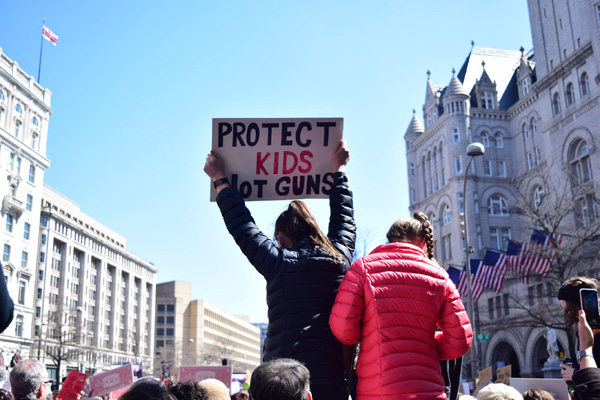
[Two young girls at protest. Photo credit to Unsplash]
A California bill that promises free counseling to young gun violence survivors cleared the state Senate Judiciary Committee on June 30, bringing lawmakers closer to treating trauma with the same urgency as bullet wounds.
About three in five children nationally never receive mental health services after a firearm injury, the Guardian reported in June.
Stigma and distrust of providers further deter many others from ever seeking help, the newspaper added.
Lawmakers named the measure the THRIVE Act, short for Trauma Healing and Resilience Investment for Victimized and Exposed Youth, the newspaper reported.
The pilot program would cover anyone under 25 who took a bullet, witnessed a shooting, or lost a family member, regardless of immigration status, according to the newspaper.
The newspaper opened its coverage with Marvin Perez, who took a bullet in his left leg at 23, just four blocks from his family's Oakland home.
The shooting filled his days with intrusive memories and his nights with nightmares, a burden heavier than his three months of physical therapy, the paper reported.
His experience traces the gap the bill targets: hospitals patch the body, then send survivors home to confront the trauma alone.
The bill grew partly out of a mass shooting at a child's birthday party in Stockton last year, where gunfire killed three children and a 21-year-old adult, the Guardian noted.
Assemblymember Sade Elhawary, a Los Angeles Democrat, authored the legislation, which would fund programs in Alameda, Los Angeles, San Bernardino and Solano counties through state grants, CalMatters reported.
Roughly 2,000 Californians age 25 and younger die or land in the hospital with firearm injuries each year, a pace that has held steady since 2016, according to the outlet.
Nicole Kravitz-Wirtz, a violence prevention researcher at UC Davis, told CalMatters that young people often leave the hospital with physical wounds treated but no clear path into mental health care.
Research links firearm trauma in still-developing young people to post-traumatic stress disorder, depression, sleep disruption and hypervigilance, a state of constantly scanning for danger, the outlet reported.
According to CalMatters, people with insurance reported waiting months to find a therapist, while those without coverage often never try because of cost.
Jazelle Eastman, an 18-year-old survivor from Vallejo, applied twice for California's victim compensation program and never heard back, she told the outlet.
Eastman said post-traumatic stress keeps her looking over her shoulder, though free counseling through Youth Alive!, an Oakland nonprofit, made the burden lighter.
In the group's model, a social worker links each survivor to a counselor before hospital discharge, though the program always runs a waitlist, counselor Rhea Corson-Higgs told CalMatters.
California's gap reflects a national pattern that persists even for insured children.
A March analysis by KFF, a nonprofit health policy group, revealed that more than 60 percent of young gunshot survivors on Medicaid received no mental health services within six months.
The same analysis tied firearm injuries to a sharply higher risk of psychiatric and substance use disorders in the following year, with worse wounds driving larger increases.
The damage spreads beyond the wounded: parents of young survivors, particularly mothers, showed increases in psychiatric disorders after their children's injuries, KFF found.
The rate of American schoolchildren exposed to a school shooting each year roughly tripled over the past 25 years, the group reported.
According to the Digital Democracy bill tracker, survivors or their guardians could simply attest to their experience without outside paperwork.
The program would run until January 2032, with the State Department of Health Care Services reporting publicly each year on its impact, the tracker notes.
One obstacle remains: lawmakers have not identified a funding source, even though an analysis pegs the cost at $7,800 per person per year, CalMatters reported.
The measure now heads to the Senate Appropriations Committee.
The bill shifts the question from how many young Californians survive shootings to how many truly recover.

- Chloe Hyeonseo Chae / Grade 10
- Korea International School (Jeju Campus)