
![THE HERALD STUDENT REPORTERS [US]](/assets/images/logo_student_us.png)
![THE HERALD STUDENT REPORTERS [Canada]](/assets/images/logo_student_ca.png)

AIMS confirms unprecedented mass coral bleaching in the Great Barrier Reef
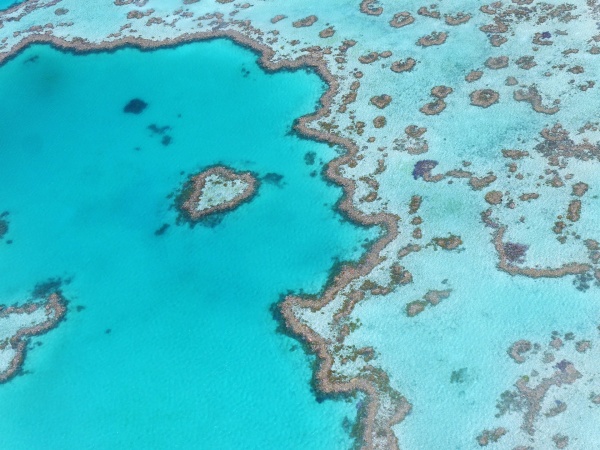
[Great Barrier Reef. Photo Credit to Pixabay]
On August 6, 2025, the Australian Institute of Marine Science released its annual report on the condition of the Great Barrier Reef.
Based on surveys conducted at 124 reefs between August 2024 and May 2025, the report found that 48% of reefs experienced a decline in hard coral cover, 42% showed no net change, and 10% recorded an increase.
According to WWF Australia, the southern region of the reef was more affected than the other regions, with higher coral mortality rates in 2025, resulting in a drop in coral cover from 38.9% to 26.9%.
AIMS noted that this was the first time substantial bleaching impacts had been recorded across the southern region, resulting in its largest annual decline since the institute began monitoring the Great Barrier Reef.
While these declines often spark debate over restrictions on tourism and shipping, reef monitoring and management involve coordinated strategies by several Australian government agencies, rather than a temporary ban on vessels or commercial operators.
For example, in April 2025, the Great Barrier Reef Marine Park Authority, AIMS, and the Commonwealth Scientific and Industrial Research Organisation jointly released a Reef Snapshot summarizing environmental conditions, coral impacts, and management actions during the 2024-25 summer.
AIMS attributed most of the coral decline measured in its report to mortality caused by the 2024 mass bleaching event.
Cyclones, freshwater flooding, and crown-of-thorns starfish outbreaks also contributed to the damage.
While another bleaching event occurred in 2025, the surveys did not capture its final effects, which AIMS stated would be assessed in its next annual report.
These overlapping disturbances are concerning because they leave reefs with less time to recover before the next damaging event occurs.
Against this backdrop, concern is no longer limited to the effects of a single bleaching season. Still, it extends to whether coral ecosystems can withstand repeated and intensifying environmental stress over the long term.
With a decade-long, consistent rise in sea temperatures, scientists are questioning coral resilience.
Instead of viewing this environmental challenge as the result of a short-term weather cycle, marine scientists have raised concerns about the reef system's long-term health, warning that it is facing ecological decline.
Yet experts caution that stacking multiple pressures and environmental stressors in these waters risks pushing the entire ecosystem toward collapse.
The latest crisis affecting one of the world’s largest marine ecosystems is prompting authorities and marine experts to collaborate in addressing rapid environmental degradation.
The growing frequency of extreme heat conditions across the world’s ocean basins is directly linked to global warming.
In marine biology, bleaching refers to the stress that corals experience due to fluctuations in temperature, light, or nutrient levels in their environment.
This stress can trigger the expulsion of zooxanthellae, the colorful symbiotic organisms residing within coral structures.
Corals can tolerate short periods of elevated temperatures for days or weeks, but prolonged heat stress can cause extensive damage to both the algae and the wider reef ecosystem.
NOAA’s Coral Reef Watch is developing new, highly functional approaches and tools to monitor ocean temperatures and assess the risk of coral bleaching worldwide.
In an effort to turn back the escalating crisis, scientists are currently studying restoration and assisted-evolution techniques that may help some corals tolerate warmer conditions.
However, these methods remain experimental and cannot replace efforts to reduce greenhouse gas emissions and other pressures on coral reefs.

- Jinhyun Choi / Grade 10
- Saipan International School