
![THE HERALD STUDENT REPORTERS [US]](/assets/images/logo_student_us.png)
![THE HERALD STUDENT REPORTERS [Canada]](/assets/images/logo_student_ca.png)

How social media affects students’ study habits
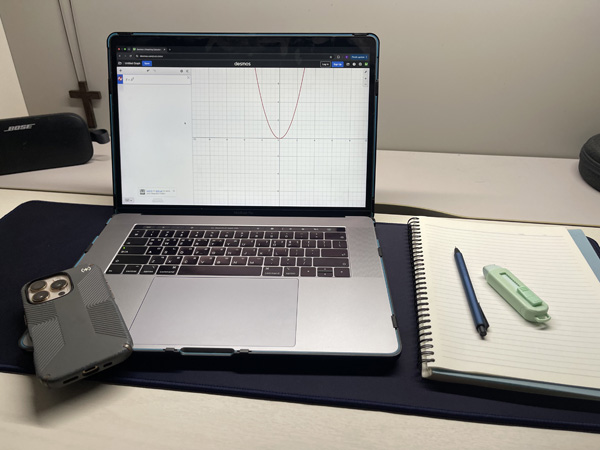
[A student's study space with a smartphone nearby illustrates the relationship between social media use and studying. Photo by Chris Park]
Two students with different social media habits both admitted that scrolling, notifications, and short-form videos can easily interrupt studying, while a middle school teacher emphasized that self-discipline and time management may matter more than screen time alone.
Social media platforms such as Instagram, TikTok, and YouTube have become some of the most common ways for students to communicate, find entertainment, and spend their free time.
According to a 2024 Pew Research Center survey, nearly half of U.S. teens reported that they are online almost constantly, highlighting the deep integration of digital technology into teens’ daily lives.
While social media provides opportunities to connect with others, share ideas, and even access educational content, some students also find it more difficult to focus on studying and completing their schoolwork.
To gain deeper insight into how social media influences students’ studying and concentration, I conducted a written interview with a high-achieving student who is senior at a South Korean high school, a student who spends around six hours a day on social media who is also a senior at a South Korean high school, and a teacher to gather different perspectives on social media and its impact.
The written interview was conducted on July 15 2026.
In a written interview, the high-achieving student explained that social media can easily become a distraction, especially when studying requires a high level of concentration over long periods of time.
Although she spends 2-3 hours on social media per day, she said opening apps such as Instagram or YouTube while studying often leads to spending much more time on her phone than she originally planned, causing her to lose valuable study time.
She explained that what begins as a short break turns into at least 30 minutes of scrolling before she realizes how much time has passed, making it difficult to regain her concentration after returning to her studies.
To reduce distractions, the student uses an app that blocks social media notifications during study time or often leaves her phone in another room to keep it out of reach and stay focused on studying.
She noted that this method helps her avoid unnecessary distractions and makes it easier to stay focused for a longer time.
The student also mentioned that she tried to reduce her screen time several times but failed to maintain healthy screen time habits because checking messages and notifications from friends had already become a habit.
Despite these challenges, the student believes that managing screen time on social media through self-discipline and setting clear boundaries has helped her improve concentration and maintain strong academic performance and high grades.
She believes that students need to build good study habits and learn to control their use of social media if they want to stay focused while studying.
In contrast, the second student, who spends around 6 hours on social media every day, responded that excessive social media usage can negatively affect studying habits and daily routines.
This student explained that most of her screen time is spent watching short-form videos, texting, and watching YouTube videos, which makes it difficult for her to stop scrolling even after intending to start studying.
As a result, social media often delays the student’s study time and reduces the time available to complete her schoolwork.
The student also mentioned that using social media late at night has affected her sleep schedule and habits, which leads to her feeling more tired and exhausted in the morning and this also leads to less focus on classes and study time during the day.
Although the student tried to reduce daily screen time to about three hours, keeping that goal was difficult because she was already so used to using her phone every chance she had.
Despite these challenges, the student believes that finding hobbies that she likes or doing activities outside of using her phone in her free time could help her reduce screen time and develop healthier study habits.
The student added that limiting her use of social media will not only improve her concentration but also create more time for studying, resting, and participating in other meaningful activities.
Another teacher shared a different perspective, saying that the impact of social media depends on each student rather than the amount of time they spend using it.
According to the teacher, academic performance is influenced by differences in students, grade levels, school environment, study habits, and attitudes rather than by social media alone.
She explained that students who are already motivated and hardworking stay focused in every aspect of their lives, and are not controlled by social media; however, they might still go through some distractions due to current social media trends and memes.
Since the teacher works at a public middle school, where students’ phones are collected during the class and school day, social media is not considered as a major distraction during class.
However, the teacher mentioned that after midterm or final exams, many students become less interested in learning right before the semester ends and believes that phones and social media are one of the main reasons which makes it more difficult to continue classes.
The teacher also pointed out that social media has some positive effects, explaining that students who post online and interact with others, sometimes build new friendships and communicate with classmates with whom they were not previously close to.
Although the teacher believes that social media can have both positive and negative effects, the most important factor in using social media is students’ self-discipline and ability to manage time and plan ahead rather than simply trying to balance studying and social media.
The teacher advised students to spend time on activities they truly enjoy, but to keep in mind that every choice has its own consequences.
Social media will continue to be an important part of a student's everyday lives, but its impact on studying and concentration depends heavily on how each student uses it.
While the two different students shared different experiences with social media, they both mentioned that it can easily become a distraction while studying.
The teacher also shared a perspective that self discipline, planning, and healthy habits are more important than simply limiting the screen time.
As social media plays a major role in everyone’s life, learning how to use it properly and responsibly may help students to maintain both their academic performances and stay connected with others.

- Chris Jun Park / Grade 11
- Rabun Gap-Nacoochee School