
![THE HERALD STUDENT REPORTERS [US]](/assets/images/logo_student_us.png)
![THE HERALD STUDENT REPORTERS [Canada]](/assets/images/logo_student_ca.png)

Satellites can now detect animal panic to hunt poachers
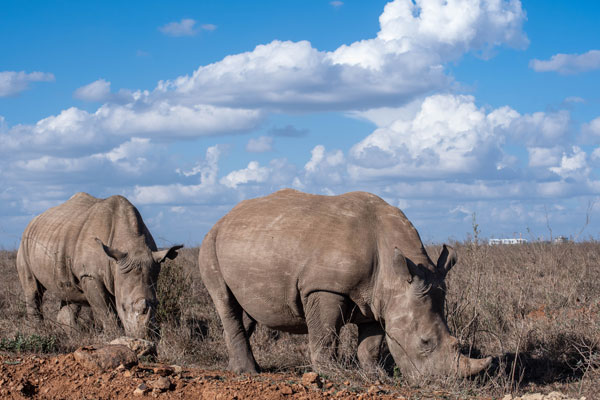
[Rhinoceros in safari. Photo Credit to Pixabay]
On November 28, 2025, the Max Planck Institute of Animal Behavior launched a groundbreaking satellite system called Icaurus, designed to track wildlife from space and detect animal panic in real life in order to catch poachers.
Poaching remains one of the most destructive forces in wildlife ecosystem conservation today, claiming the lives of an estimated 100 elephants across Africa every single day for their ivory.
Traditional anti-poaching methods relied on active foot patrols, which were often a losing battle against well-organized and armed networks operating across thousands of square kilometers.
However, the satellite Icarus has transformed this entirely by equipping animals with miniature ear-mounted tags that record GPS location, movement, heart rate, body temperature, and atmospheric pressure, transmitting all of it to satellite receivers in orbit.
When a poacher approaches, the surrounding wildlife reacts, where each species expresses panic differently, creating unique behavioral signatures.
Using predictive analytics and algorithmic technology, these biological signals are analyzed, triggering rapid-response alerts for anti-poaching teams using the satellite, even from distant locations.
To build this algorithm, researchers ran approximately 30 simulated poaching events over three days at Namibia’s Okambara reserve in mid-2024, recording each species’ reaction from an overhead drone.
Springbok bounced chaotically, zebras broke into full gallop, and wildebeest fled hundreds of meters, while giraffes remained still, calmly aligning their heads toward the direction of the threat.
This is important as giraffes are the perfect living compass for the poachers, as heads are pointing in the same direction, aiming directly at the intruder.
The diversity of these responses is precisely what makes the system powerful, as cross-referencing panic signals from multiple species simultaneously allows the algorithm to measure a poacher’s position far more accurately than any single animal’s reaction alone.
When deployed in live conservation settings, the results proved that out of 400 wild dogs in Kruger National Park, 80 of the dogs were freed from poacher snares using a tag-based alert, which showed a significant impact on those vulnerable populations.
Beyond individual animal rescues, the system has helped the team reconstruct exactly how poachers entered the park before rhino attacks.
Tags on both ears send out an automatic mortality alarm if neither is moving, allowing a reach to the animals within hours rather than finding their loss days later.
This is particularly critical since more than 10,000 rhinos have been poached in South Africa over the last 15 years, with 175 killed in Kruger alone in 2025, according to the International Rhino Foundation.
By mid-2027, six Icarus receivers will be in orbit, extending this coverage to unmonitored regions such as the Congo Basin and the Amazon, where poachers have historically operated across the vast and borderless lands.
Martin Wikelski, director ecologist, stated that he hopes to tag 100,000 animals globally by 2030, wiring the entire animal network chain.
He finally answers the questions that scientists had accepted as unanswerable regarding the locations of wild animals, their migration patterns, and where they die.
For the first time in history, wildlife conservation has a real-life surveillance system, which could significantly limit poaching.

- Sogyu Kim / Grade 10
- Korea International School