
![THE HERALD STUDENT REPORTERS [US]](/assets/images/logo_student_us.png)
![THE HERALD STUDENT REPORTERS [Canada]](/assets/images/logo_student_ca.png)

The 2025-2030 Dietary Guidelines for Americans introduced a new food pyramid that flipped the traditional model upside down
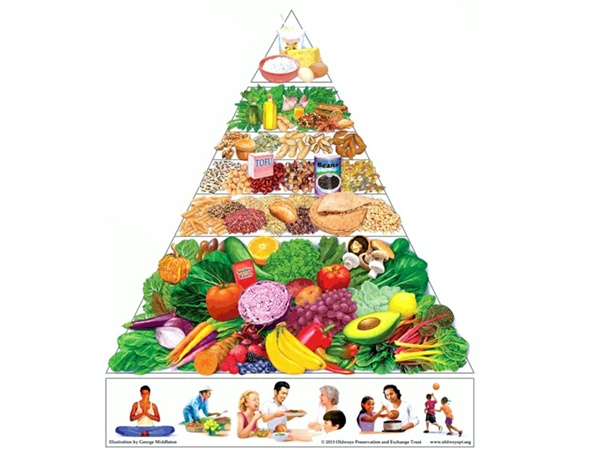
[the original food pyramid. photo credit to unsplash]
The 2025-2030 Dietary Guidelines for Americans (DGAs) have sparked much controversy by completely upending the traditional food pyramid.
The DGAs are updated every five years, with the process overseen by the United States Department of Agriculture (USDA) and the Department of Health and Human Services (HHS).
On January 7, 2026, the USDA and HHS unveiled the latest DGAs, introducing a groundbreaking new food pyramid— one that was essentially a complete inverse of the original food pyramid.
Press Secretary Kraloine Leavitt remarked that this new announcement, the new pyramid, aligned with President Trump and Health Secretary Robert F. Kennedy Jr.’s promise to “Make America Healthy Again.”
As Kennedy himself also stated, “As secretary of Health and Human Services, my message is clear: Eat real food.”
Kennedy also described the pyramid as “the most significant reset of federal nutrition policy in history.”
True to his words, the pyramid had undergone a drastic transformation from the one we remember.
The new pyramid now features food groups that should be consumed in abundance at the very top, while those that should be eaten less were placed at the narrow bottom.
Grains, once forming the large base of the triangle, were now relocated to the smallest group.
Conversely, protein, dairy, and healthy fats were relocated to the largest sections at the very “top” of the triangle.
Upon closer analysis of the pyramid, it’s possible to understand the message “Eat Real Food” was advocating for: to prioritize the consumption of “healthy” fats while minimizing highly processed product consumption.
Protein also became a key priority— the recommended protein intake, which was initially at 0.8g per kg, was increased to 1.2~1.6g per kg of body weight daily.
Fat consumption, which previous guidelines suggested minimizing or even avoiding completely, is now encouraged— in fact, three servings of full-fat dairy are recommended a day.
Interestingly, the guidelines now include whole-food sources of fats that contain saturated fat. However, the limit for saturated fat intake is still under 10% of calorie intake.
Funnily enough, while grains are moved lower in the pyramid, the written recommendations still suggest 2~4 servings a day, indicating that the visual doesn’t fully reflect the quantitative advice.
In contrast, a “war” was declared on sugar. The guideline now caps sugar consumption at less than 10% of daily calorie intake, even going as far to encourage avoiding it entirely.
Alcohol intake guidance also became much more vague compared to previous limitations.
Instead of placing a numerical limit on alcohol like the previous guidelines did, it merely advised to consume less alcohol.
Overall, the pyramid had changed significantly— a change that brought many mixed reactions.
Some health organizations, such as the American Medical Association (AMA), applauded the new pyramid for “spotlighting the highly processed foods, sugar-sweetened beverages and excess sodium that fuel heart disease, diabetes, obesity, and other chronic illnesses.”
AMA President Dr. Bobby Mukkamala also added that “the guidelines affirm that food is medicine and offer clear direction patients and physicians can use to improve health”.
However, critics point out that the new pyramid is counterintuitive, and many experts disagree with parts of the guideline, especially regarding saturated fat.
The AHA shared concerns of promoting foods such as butter and red meat as “healthy fats”— it could “inadvertently lead consumers to exceed recommended limits for sodium and saturated fats, which are primary drivers of cardiovascular disease.”
As differing reactions continue, the long-term health effects that the new pyramid brings remains uncertain.
Only time will tell whether this shift will improve public health outcomes or create more confusion.

- Chloe Yeona Choi / Grade 10
- Saint Paul Preparatory Seoul